02 December 2015

How Obituaries (Both Old and Recent) Can Be a Boon to Your House History

As I have posited previously, the people who have owned, occupied, or even rented your house as tenants in the past are collectively what comprise the soul of your house's historical story. Aside from tracking down and investigating the physical history of your house as an object, it is the historical lives of the home's people who will really enrich your research beyond a mere statement of facts. Thus, we will seek out information about their lives as best we can. Once you have completed your house's (land's) chain of title, you are left with a list of previous owners to research further. There are many genealogical sources upon which you can draw to reconstruct the lives of these owners and other occupants, and one important one is published obituaries or death notices of previous occupants. While obituaries are a common source for genealogy research, there is also a very specific way these articles can aid a house history research by leading you to living people who can possibly act as further sources of information.

What Will You Find?

The long and the short of it is that you just don't know what exact information you might find until you locate the obituary. You may find alot or you may find not much at all described in the obit-- but that's the reason to look! There is one important clarification of terminology here. Although often grouped collectively under the term "obituary", death notices and obituaries are two different types of articles. A death notice is a usually somewhat brief formal announcement of a person's death, stating the primary facts as provided by the deceased's family. They often state such things as when the person died, potentially where he/she passed away (such as at his home), when and where he was born and/or raised, who his survivors are, perhaps a brief statement of his previous occupation(s), funeral specifics, and often interment location. A true obituary, on the other hand, is a more lengthy article written as a profile piece, often by a newspaper writer using information provided by the family. A true obituary is not paid for, as a death notice is, and is published at the discretion of the publishing entity (i.e. newspaper). For fairly obvious reasons, they can be a wealth of information, providing you a detailed account of the subject person's life in narrative form. Most past persons which you are researching will be documented in death notices; not in a true obituary which are in much, much fewer number. Please note that for the duration of this article, I will use the term "obituary" to also mean a death notice, as is commonly done.

Looking to the Past - Information on Former Occupants

For your house history research, you should now have a list of previous owners obtained in your title searches (if not, read here). I have gathered a list of 7 married couples who held ownership of my home or it's land since this home lot was created in a land subdivision (earlier owners of the larger land tract, of course, should ideally also be researched). Obituaris should be sought for all 14 persons. The 2002 death notice of Catherine Cantlin (the longtime matriarch of the home from c. 1932 to 2001) tells me that she was born in the city of Philadelphia, lived her life primarily as a homemaker, and passed away at a nursing home not far from the home she loved. I've also learned here that her maiden name was Stearn, that she is buried at the large Catholic cemetery a few miles away, and that her husband John and two of their children preceded her in passing.

Death notice of Catherine Cantlin, published 2002 in The Times-Chronicle.
Don't forget to search for obituaries for other relatives who may have also occupied the home, such as the owner's children. From census records, I've learned that John and Catherine had three children: Jean (aka Claire, born c. 1927), John Jr. (born c. 1929), and Robert (born c. 1934), all of whom lived in the home during their childhood. To date, I have located the death notices for one of these three children. While you will not always find staggeringly interesting or noteworthy information, these bits of information will help you reconstruct the lives of these people along with other sources. They lived in your house after all!

Before we leave the "Ghost of Cantlins Past", a note that extended family should not be dismissed. Again, through census records, it was not difficult to determine the parents of John Cantlin as James and Sarah Cantlin, Irish immigrants. Locating the death notice of Sarah Cantlin from 1944 yielded that a remembrance service for her was conducted at my house! The discovery of events such as this which took place at the house can really bring to life to your house's story.

Death notice of Sarah Cantlin, published July 26, 1944 in The Philadelphia Inquirer. This informs me that a portion of her funeral services were conducted in my house.

Looking in the Present - Finding Living House History Sources

Allow me to stress that the greatest value you might get from a thorough obituary search is by locating living descendants of those associated with your house. Obituaries, in combination with current public records, phone books, and maybe even Facebook, can lead you to people who are alive and who just might be able to tell you something of interest about your house.

Consider again the Cantlin family. The long-time owners of my house, John and Catherine, passed away in 1961 and 2002, respectively. Their three children have all also passed away, the last of which in 2008. Through searching for other obituaries within this family, I came upon one for another family member who passed away in 2007. It turns out that this obit was in reference to John Jr's son (John Sr's grandson). Examining this obituary reveals names of several living descendants of John and Catherine, including two daughters-in-law and four now-adult grandchildren. These are all potentially persons whom I can respectfully contact and ask if they are willing to share any memories, either of the house itself or of these folks John and Catherine, whom I have thus far only come to know on paper. This single obituary is the key to a potential bonanza for the house history.

Sources for Obituaries and Death Notices

There are many potential sources for finding obituaries. I preface this by saying that aside from doing a "blind" name search somewhere, it is generally most helpful to track down the date of death of the person first. This can admittedly take some time and further research, especially for those who passed prior to the information age resulted in an online footprint of virtually everybody. This is where using Ancestry or another online or offline genealogy family tree will come in handy, as many of these put clues and source documents right in front of you. I will get into this topic more another time.

The first and most logical place to start searching for obituaries is in newspaper archives. One can usually pretty easily search many newspapers online for obituaries which are only a few years old. A daily-increasing amount of historical newspapers are being digitized and placed on websites such as Genealogy Bank, Google Newspaper Archives, and Newspapers.com.  However, still, most often you will need to head to a local library to view past issues of newspapers on microfilm (I personally, even as a Millennial, am incredibly thankful that my research has forced me to use such great resources as the local library).

Other sources might include less-obvious places such as social clubs or fraternal organizations. However, unless you knew the person, you likely do not know of their involvement in such an organization until you find, ahem, their obituary. Still, even if you learn of it after the fact, sometimes you can find old meeting minutes or newsletters of such organizations which might include a brief biographical sketch around the time of death of a member, yielding more information than a standard death notice.

Funeral homes are another source, as they often even assist with the obituary publishing process. Nowadays, many funeral homes include current and recent obituaries on their website. For older obituaries, you might consider contacting local funeral homes in the area where the person lived to see if they handled that person's funeral and if they have an obituary on file.

Lastly (and this list is not meant to be exhaustive), there is www.findagrave.com. This is an online search catalog of virtual "memorials" which correspond to real gravesites in real cemeteries. The information is entirely comprised of user-submitted contributions, but it has a tremendous following and, to date, over 138 million grave records, growing daily. Some of these virtual memorials include the text of the deceased person's published obituary, with the source listed. The percentage which include obituary information is small, and one must fact check a source like this, but I have come across it enough to cause me to check the site when looking for an obituary.

Good luck finding all those obituaries!
Read More »

28 November 2015

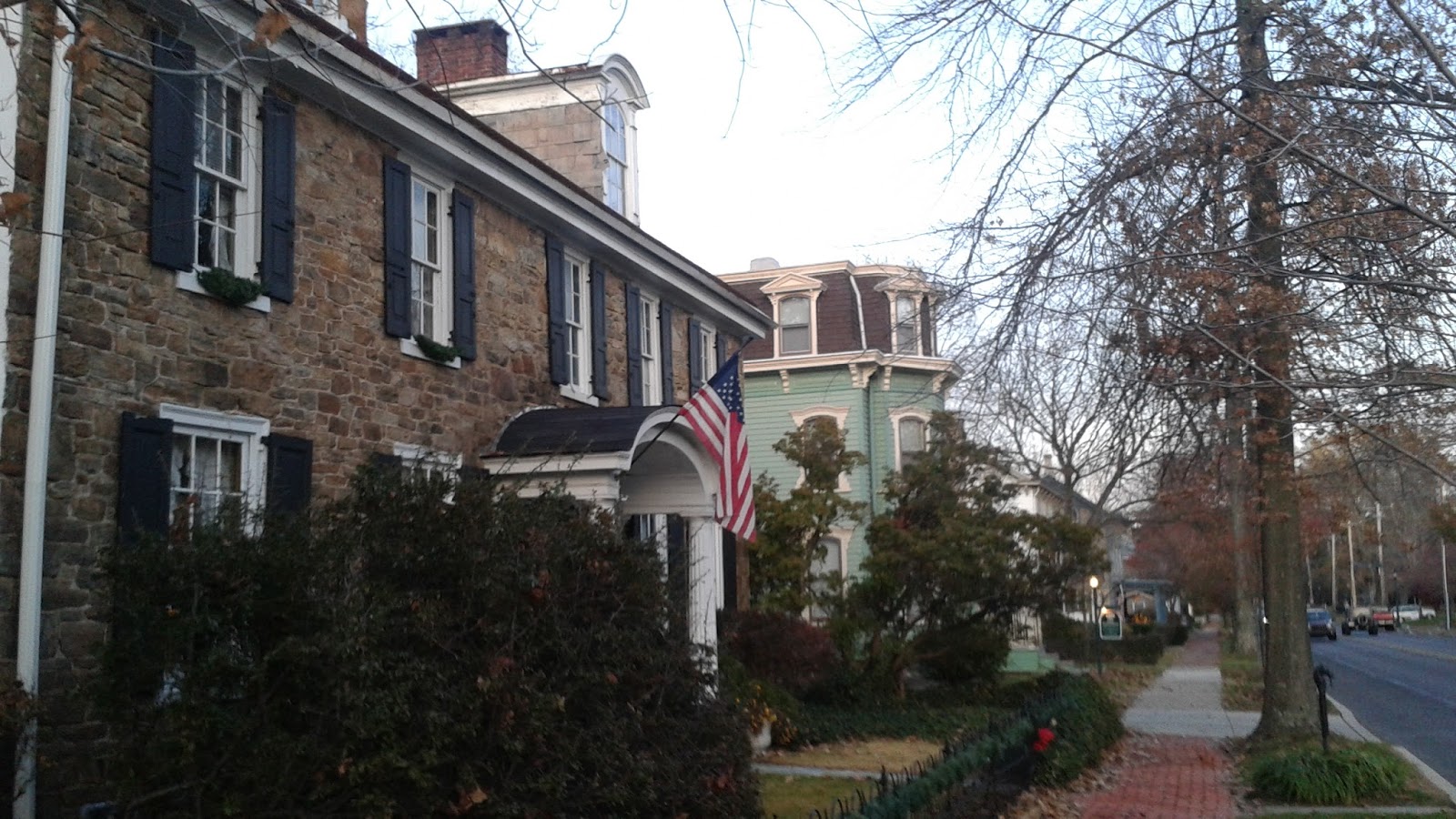
Saturday Spotlight- Circa 1779 Adamesque in Langhorne

This week's Saturday Spotlight house is a stone Adam-Style in Langhorne, PA.


I always really enjoy walking down historic "Main Streets" such as Maple Avenue in Langhorne, especially when there has been a concerted effort to celebrate that history with coordinated "date of construction" plaques displayed on the front facades of each house. This 2-1/2 story side-gabled house is approximately 3,300 square feet and exhibits an architectural style known as the "Adam" Style, or Adamesque (after the influential Robert Adam and his brothers, all Scottish architects practicing in England)-- also colloquially referred to as "Federal" style due to its emergence upon our nation's birth in 1776.

Around this time period, many American homes and architecture began to incorporate more refinement and classically-influenced flourishes, popular in Europe, into the early Georgian-period style. Like that earlier style, this home is a symmetrical box with a five-ranked facade, wood-paneled shutters, and double-hung sash windows. What makes it Adamesque is, most significantly, the elliptical portico and fanlight above the front entry. These elaborations as well as the sidelights were very common in this style, and further distinctions from a Georgian include the 6-over-6 window sashes (which used larger panes of glass then pre-Revolution windows) and the arched windows in the roof dormers.  One oddity, is the "center" window above the main entrance-- it is rare for windows to break from the strict symmetry in this style. The one-story portion to the left-side of the house was likely built after 1891.


Origins to 1890

I will allow that the 1779 date displayed on the historic plaque is almost certainly based on more extensive research than I have performed here, thus I will go with that date as opposed to the circa 1800 I would likely otherwise have prepared. The Bucks County tax assessor lists a date of 1770, which is unlikely, as the Adam Style did not begin to dominate until around 1780. The earliest map I was able to locate of this area is from 1876, when the name of this town was changed from Attleboro to Langhorne. This house would have been built a few decades after early settlement, with what is now the Langhorne Hotel being built around 1700, and the Richardson House across the street dating to 1738.

Clip from an 1876 map of the block, with Ms. Eastburn's Adam Style house shown at the corner of Maple and Green Streets.

In 1876, the Adamesque house was owned by a Rachel Eastburn, a housekeeper listed as a 70-year-old single woman (not widowed) in the 1880 US Census. She was the sole occupant at that time. There appear to be 3 different Rachel Eastburns of similar ages living in Bucks County in the second half of the 19th century (with 2 of them living next door to each other in 1850, almost certainly related), and furthermore most of the residents on Maple Avenue appear to have been Friends (Quakers), many of which were related through several marriages. Both of these facts have made tracking the correct Rachel Eastburn a difficult exercise, short of developing a robust family pedigree chart. However, I am fairly certain that Ms. Eastburn arrived in Langhorne between 1870-1876, settling near some Quaker relatives after passing through Solebury Township and Yardley in previous decades. She appears to have remained as a single lady throughout her days, having at one point lived with her niece, Rachel E. Shaw, who eventually joined her in Langhorne at the Second Empire home next door. Rachel Eastburn owned the house through at least 1886, presumably through her passing away circa 1890. She is buried at the Solebury Friends Burying Grounds.

Ms. Eastburn's Adamesque home in foreground; her niece Rachel Shaw occupied the Second Empire home in 1886.

1890 to Present

The next half-century of history at the Adam Style house saw a steady stream of ownership changes, according to a survey of available census records. In 1891, an "R. Ivins" is shown as the house's owner on an atlas map, and in the 1900 census it appears that a 60-year-old day laborer named Lewis Grant and his wife Harriet owned the home, living there with their daughter Ethel.

By 1910, a young family headed by 30-year-old bank teller Russell Clayton took up ownership. Mr. Clayton had a 24-year-old wife, Mabel, and a 3-year-old son, Horace. In addition, as the Claytons took on the mortgage for their new home, they took in boarders in a 28-year-old widow and her 8-year-old son. The 1920 census was not legible enough to confirm the address, but the Claytons still lived in Langhorne somewhere near this address. Similarly, this address is curiously skipped in the 1930 census schedule, however by this time the Claytons had relocated to Kingston, New York.

From at least 1935 through 1940, 71-year-old widow Grace Matthews and her single 50-year-old daughter, May, owned this home. May appears to have lived with her mother most of her life, as Grace and husband Joseph Matthews raised May in Philadelphia, before moving out to Langhorne by 1920. Grace Matthews passed away in Langhorne in 1945.

In 1957, this house at the corner of Maple and Green Streets in historic Langhorne was purchased by Kenneth and Mildred Hough, who owned it for five years until conveying ownership to another Mildred, Mildred Crown and her husband Richard. This couple, too, owned the home for a period of five years.

Finally, in 1967, the current owners, Chris and Mary Blaydon, purchased the house. Christopher Blaydon is of particular note, having served as Mayor of Langhorne for 20 years from 1993 to 2013. Mr. Blaydon is also a retired airline pilot, having served in the U.S. Air Force as an active duty officer. By all accounts and this article penned upon the end of his tenure, Blaydon was instrumental in preserving and improving the fine historic avenue that Maple Avenue is today.
Read More »

24 November 2015

Attention All Recorders of Deeds-- Be Like Berks County!

Early on, I outlined how you can access online databases at some your local county government offices to help kick-start your house research, before heading there in person. Although I cautioned against assuming that all of your research questions can be answered online, there is one county nearby that has made incredible headway in the online frontier.

Welcome to the County of Berks

Although I do not live in Berks County, PA, a large percentage of my ancestry is rooted there, and the city of Reading, the county seat, is only about 70-80 minutes from my house. My grandmother grew up there. Thus, I've become familiar with searching records there, and I have to say that this county is doing alot of great things in terms of making records accessible to their constituency, researchers alike, and the public at large. The county's Register of Wills has some great searchable indexes for birth, marriage, and death records. Although that office's actual records are not available online (yet), they make it very easy for one to do alot of prep time ahead of visiting their office in person, by giving you all of that index information- the dates, volumes, and page numbers right there online. That makes it incredibly easy to get right to finding the actual records you need once you are there in person (or just as easy to request them by mail). The Register of Wills even gives a bit of his own personal genealogy on his bio page!

Deeds Online Galore!

But let's get back to houses, shall we? Berks County takes it to the next level over at the Recorder of Deeds office. The current Recorder, Fred Sheeler, has been leading his staff since 2008 in an incredible effort of records digitization. According to their website, essentially the entire collection of deeds recorded in the county since its founding in 1752 has been digitally scanned and is available for residents and researchers to access online. Although not all of the images are indexed by name and searchable as of yet, it appears to me that a great number are. The Recorder's office states that their goal is to have all of their documents back to 1752 indexed by name and searchable, making it even easier for researchers to find what they are looking for.
(Update: Fred Sheeler provided this clarification to me regarding online searchability: "All the documents are searchable just not by the modern name search capability.  All older documents that we have not fully indexed are still searchable by our online electronic version of our index books.  When you are on the search site just choose Index Books as the search criteria,  you enter the party’s last name and the first initial of their given name and all the index books will display.  You can choose from the deed grantor and grantee indexes or the miscellaneous or mortgage indexes.  They are actually better than a regular modern name search since the index books group similar sounding names together so if you had an ancestor with the name Snyder and it formerly was spelled as Snider you would still come across it."
Thanks Fred for the clarification: this is useful to know and sounds similar to the way I search for deeds in person at the computer station at Montgomery County, whereas Berks has it online. Although a fully indexed database is often easier to use for those unfamiliar with these record types, researchers should be familiar with searching records using index books as well, as it is not difficult and can yield persons of the same surname, who could possibly be related, or with similar spellings as Mr. Sheeler suggests.)

Also available are mortgage documents and even subdivision plans. Yes, I repeat, these document images are all online! If you live in Berks County, the process of chaining the title for your house history research could be complete within an hour or so without even going to the county offices. The images can be printed or saved for $1 per page. (Update: Sheeler informs me that images are 50 cents per page, plus $1 when using a credit card in order to cover processing fees. Below, I was looking at a 2-page document, which would be ($0.50 x 2) + $1 = $2.00). Note that, as of now, the image viewing capabilities are based on the outdated Java platform and only seems to work on Internet Explorer (for me at least), but supposedly this drawback is known and is actively being updated to an HTML platform.

Public Outreach

Sheeler is clearly interested in the public actually being able to use and understand these public records. The office now puts out a periodic e-newsletter to provide updates to Berks residents on its efforts to streamline the deed recording process, bringing it into the 21st century while maintaining the integrity and security required of this governmental recording process. Sheeler also makes himself available to give instructional lectures to local groups on how to access and use these databases. Last month, I received the latest newsletter and was extremely interested to learn of this 5-minute video, produced by the Recorder's office, discussing the evolution of deed recording in the county:


I Digress (By Trying It Myself)

With all of this great information out there, although it did not benefit my personal house history directly, I had to try some of this out to enhance my personal genealogy research. I accessed the online database, and did a general search for my great-great-grandfather, Henry F. Snyder. There were 61 hits in the search for "Henry Snyder", 5 of which I could immediately tell were my ancestor. I knew because they were associated with property in Reading, where Henry lived, included his known middle initial "F", and also listed his wife, my great-great-grandmother Maggie. I went to one of the document images:

Screenshot of a scanned document image for a property deed, involving my great-great grandparents Henry F. and Maggie Snyder as the grantors.
In this particular deed, I learn that Henry and Maggie Snyder, in 1946, were conveying their 2-1/2 story brick house to a Ms. Edna Long, for the consideration amount of $1 (clue to check for a corresponding mortgage!). The address of the house was 736 Thorn Street, in Reading, and the deed further states that this is the same premises which Henry acquired in 1922 from Michael and Elizabeth Hill. Sure enough, my great-great-grandparents are listed at this same address in both the 1930 and 1940 censuses.

Clip from the 1940 US Census schedule, showing Henry and Margaret Snyder. The address number "736" is listed in the first column, with the street name "Thorn St" listed in the margin.
I was curious to see if I could get a Google Maps Street View of this house, assuming the house still exists. It does, but unfortunately, it looks like the Google car hasn't made it to this street (I was surprised!). Next time I find myself in Reading, I'll have to try to take a swing by.

Google Maps image. The brick dwelling at 736 Thorn St appears to still exist, but the Street View car hasn't captured an image of it as of yet.

Other Recorders on Notice!

I personally think that what Mr. Sheeler has done with the historic records at the Berks County Recorder of Deeds is incredibly commendable in terms of government accessibility and transparency, as well as in the preservation of important legal and historic documents. This is by no means a political website, but in many areas, the Recorder of Deeds is an elected position. If the county where your home is located isn't working to digitize documents, find out if there are plans to do so in the future from your current Recorder. The reality is that something like this takes years to execute, and often budget constraints make such efforts difficult. However making your voice heard as a local constituent can go a long way towards the effort of bringing records preservation into the 21st Century. Perhaps there would even be an opportunity to volunteer. Tell them to learn from Berks County!
Read More »

19 November 2015

"Husealogy": Genealogy for the House

Thirty posts into this blog, there is one thing I hope is clear to all of my readers-- there is information out there to be found about every house, if one knows where to look. What I am doing here isn't proprietary, it isn't a secret; yet at the same time each house's history is unique. It is is NOT all out there in one spot, ready for you to simply ask for it. We are sleuthing here-- searching, uncovering, and discovering all of these little bits from various sources to create a history of this dwelling. For these reasons as well as due to the nature of their similar content and source types, the best parallel I can draw to another genre of research is to the field of genealogy-- the history of one's family. If I were to provide an etymological name for the study of one's house, I'd call it "husealogy", from the Old English word hus, meaning a residential dwelling.


Genealogy of the House- "Husealogy"

On the face of it, many of the similarities to genealogy are pretty simple. In the study of family history, the researcher is generally looking backwards in time to learn about his/her roots, about those ancestors that came before him and who in some small way, collectively make the researcher who he is today. It is a study in sociology and cultural history, which provides context and gives depth to the life of an ancestor beyond the simple Birth/Marriage/Death facts.

When researching the history of the house, I am looking for this exact context. Sure, I am looking for the date that the house was constructed, but I am really searching for much more. You have seen and will continue to see me delve into three primary components in my house history research: physical materials, people, and neighborhood. In my mind, a high quality house history examines not just the basic "Birth" date of a house and its additions (the physical), but also those people who have come and gone, as well as some history of its surroundings.

People

You have seen me discuss many of the past owners and occupants of my home. Now, while a genealogist discovers new people in their family tree, or pedigree, by rooting out the descendants (mother, father, grandparents, etc.) of a known person, a house historian will do this differently. Since previous owners of the same physical house are very often not related to those who owned it before them, new subject people are discovered by a process called "chaining the title" by going backwards through the deed history of the property. I have outlined this process previously and have also shown some of the results of my particular searches.

However, once you know some of the past persons involved, the husealogist will use many of the same record types as the genealogist to learn more about those people. Census records are a foundational building block with which to learn more about previous owners. Birth records, death records, photographs, wills and other probate records, gravestones, and phone directories are all out there, up for grabs, and are familiar genealogical tools. As a good genealogist will tell you, nearly any record type has the potential to be a source, if credible and relevant. Personal interviews, as in genealogy, are incredibly important (I can't wait to share an extremely important interview I conducted in a future post!). Gathering information about the people involved will give you a truer sense of the history of your house.

Physical Materials

This is where a husealogist is more like an archaeologist than a genealogist. In my "Finding Physical Evidence" series of posts, you have seen me look for hard clues within the actual fabric of my house. These are things like remnants from previous renovations, as well as original materials which may have since been hidden. Once you find them, then you must either draw upon your existing knowledge of different house components and building materials, or you must seek out additional knowledge on these topics. For instance, although I already had a general historic timeframe for the prevalence of asbestos-cement shingles, I had to do additional research to understand the history of the material more and to narrow down their possible installation time period.

The genealogist will, however, take notice that there also are historical documents upon which further evidence is built in this realm. I have drawn upon historical maps quite heavily to investigate the physical existence of the house and addition, and I have sought out other documents such as photographs, and old permits at my local municipality to understand even more about the evolution of the home's construction.

Neighborhood

Even a residential neighborhood can have it's own genealogy so to speak, as it has certainly evolved over time. In this sense, the house historian becomes a local historian of sorts. In my own neighborhood, I have yet to discover an account of the history of my specific subdivision other than that which I have written, although some other research by others is likely out there waiting for me. The history of the subdivision leads you further back to the history of early landowners in the area, which should lead you to your local historical society to learn more. This earlier land research inevitably brings your research into the realm of probate records, early property deeds, and perhaps even land grants- all familiar territory for seasoned genealogists.

Conclusion

Conducting house history research should be relatively familiar territory for family history researchers, and is certainly achievable for those just beginning. Finding your house's history makes you simultaneously a genealogist, local historian, and in some ways an architectural historian and archealogist. In total, a husealogist. The physical thing that is the house, of course, has its own evolution. The people are an ingrained part of the homes in which they live, and an understanding of them gives you a richer house history. Carrying it beyond the house to the community at large (as well as placing it in larger nationwide historical context, by the way) brings the history home. What really compels me about researching my house is that no one has done this exact research before-- I am the first one to compile it all into one comprehensive study. Each house's story is completely unique-- find yours!
Read More »

17 November 2015

Finding Physical Evidence: Original German Siding

With a 90-year-old house, even without all the historical research I have conducted, it would be clear to most anyone that the house has undergone physical and aesthetic changes over such a time period. Owners renovating historic and century-plus old homes find evidence of former floor plan configurations, old hardwood floors, and other old or original building materials all the time. One might think that the most likely time to find such physical evidence is during a significant renovation project. While that may indeed be true, sometimes finding a major score of an original building material is as simple as poking your head into an access panel in the attic...

The Current Asbestos Siding

As I have mentioned several times, my house is clad in asbestos-cement shingle siding. The word "asbestos" is a dirty word these days, as it should be since it is a well-known carcinogen. However, prior to this knowledge and up to the 1970s, asbestos fibers were used extensively in the 20th century as a major component in all sorts of building materials, touted for increasing durability and fire-resistance. In this type of exterior siding, asbestos fibers are embedded into a tile of portland cement. Since asbestos house siding is a non-friable ACM (asbestos-containing material), there is no great rush for homeowners to go to the expense of ripping old asbestos siding off of their homes. Left in tact, there is generally no hazard. Earlier asbestos siding can date back as early as the 1920s, with the material becoming more prevalent in the 1930s and hugely popular in the 1950s.

Asbestos-cement siding on the side of my house. At this area, a window had been covered over. The owner at the time mixed the wavy bottom style in, which is a mismatch to the earlier flat bottom shingles. This newer wavy bottom shingle may also be a more modern fiber cement product without asbestos.
Asbestos siding is also today seen by many as an unattractive siding material. It most often came in white or shades of grey (especially prior to WWII), with either a straight or wavy bottom profile, and many times has a faux wood-grain pattern on it. If painted to create a cohesive color scheme with the trim and other materials, asbestos siding can look just fine and even quite nice. I happen to think that the previous owners of my home did an admirable job with the previously-white siding, painting it an olive green and accenting with magenta shutters and a storm door.

Yet, I know for sure that this not the original siding to the house. Although asbestos siding was available in the 1920's when the house was built, wood siding still prevailed during that time period. My siding has the faux wood-grain pattern, which was not available until the late 1930's. This siding no doubt came sometime later on many years after the home's construction.

The Original Siding: Wood "German" Siding

Knowing that there was a major addition to this house, occurring no later than 1946 with the enclosure of a rear porch, it hit me like a lightning bolt one day a few months after moving in. Why not check the attic, in the unoccupied portion where the addition is? I have a walk-up attic housed above the original portion of the house, and there is an opening at the top of the attic steps, providing access above the ceiling at the addition. If I poke my head through the access opening and look back at the outside face of this wall, I would be looking at what was original the rear exterior facade of the house.

Looking up the attic steps, the exterior wall to the right was originally the backside of the house. The access opening is to the right of the window, sort of visible, with a board over it.
I grabbed my utility worklight and headed upstairs immediately, and found it:

Original German wood siding, on what used to be part of the exposed exterior rear wall of the house.
This is what is commonly known as German siding (also known as "cove lap" or "Dutch lap" siding). Whereas wood clapboards and beveled siding are installed by overlapping the upper course over a lower course and nailing through one or both boards, creating an angle to shed water, German siding is a type of "drop siding", milled from wood in a profile that gets nailed flat onto the exterior sheathing. German siding has a coved profile that creates an attractive relief pattern and locks adjacent courses together. It was widely popular in the late 19th-century, especially in the Northeast.

Diagram of German lap siding, courtesy of www.dictionaryofconstruction.com
Image of a building with German lap siding, courtesy of www.cranesiding.net
So now this has me excited. I now know what originally clad the exterior of the house. Don't forget, also, that the 1946 building permit for the rear porch enclosure indicated that this portion of the house too had German siding:

Clip from the 1946 permit application to enclose the rear porch-- notice the words "german siding" at bottom right under the section calling for building materials used.
Originally after making this discovery, but before I received the permit document, I assumed that the replacement to asbestos siding occurred on or around the time that the addition was built. However, the permit proves that this portion of the addition was also clad in German siding in 1946, and makes it highly probable that the earlier German siding was still extant at that time. Now it is more likely assumed that the asbestos was put on in the 1960s, giving it some temporal distance between the Cantlins' spending money on more new German siding in 1946. Asbestos began to become more regulated by the EPA in the 1970s, although sale of this type of siding did continue into that decade.

So, Is There More Underneath the Asbestos-Cement?

Short answer, I don't know, and won't unless I begin to take some of the asbestos siding off (safely and with proper precautions!) along with the building felt directly underneath it. I can, however, posit that it is likely that there is old wood siding there. First, removing an existing siding is an additional expense and was (and still is) often skipped when re-cladding a house. The Cantlin family probably did not go to this expense. Further, when vinyl siding is added over top of an existing siding, the additional depth it creates begins to cause window trim to become recessed within the vinyl trim (yuck). The same thing does not happen with asbestos-cement shingles, since they are only about 1/8" thick. Notice on pictures of my house that the original wood window trim still has a bit of dimension to it between the siding and the front face of the trim.

Window trim is not recessed as it is in vinyl cover-ups.
Diagram from Asphalt and Asbestos-Cement Shingle Residing, by James McCawley, published 1940.
Look also at this installation diagram above for this type of asbestos-cement siding from 1940. The likely method of installation included placing a building felt over top of existing wood siding, then nailing in the asbestos siding directly over that. Although this same method could easily be done over sheathing after wood siding is removed, it is quite possible that the wood siding remains. In areas on my house where asbestos siding has been chipped, cracked, or broken in a few areas, I see either black building felt or another asbestos shingle (i.e. at the bottom course). In a few areas, such as when i try to peek underneath the bottom course or look at gaps in these same locations, I do see wood, but this could easily be sheathing or a wood nailer.

Possibly some more older wood siding, exposed beneath the bottom course of asbestos shingle.
I THINK all or most of the original wood German siding lurks under there, but I can't be sure. Yet.
Read More »